


Noticing any unusual sounds coming from your engine bay can be daunting, as you know there’s something not quite right in your powertrain. One of the more frequent of these to encounter is a high-pitched squeal from your engine.
While there are various potential causes of engine squeal, some minor and some serious, it’s crucial to bring your vehicle to a trusted auto repair professional for an inspection if you’re experiencing a similar symptom.
In this article, we’ll go over some of the most common causes of a squealing engine, how these issues occur, and what it could mean for the health of your vehicle.
Common Causes of Engine Squeal
Worn Timing Belt
The timing belt is responsible for keeping each of the various valves and actuators within the engine engaging at a precise time as your engine goes through the steps of combustion. When the rubber-like material of this belt begins to fail due to old age or damage, it may allow the belt to stretch, loosen, or even slip from the pulley.
When the timing belt is experiencing even a small issue, it can have major consequences for your engine. Mistimed valve actuation and injector firing can quickly cause a host of issues in your powertrain, specifically on interference engines where the valves can collide if not properly timed.
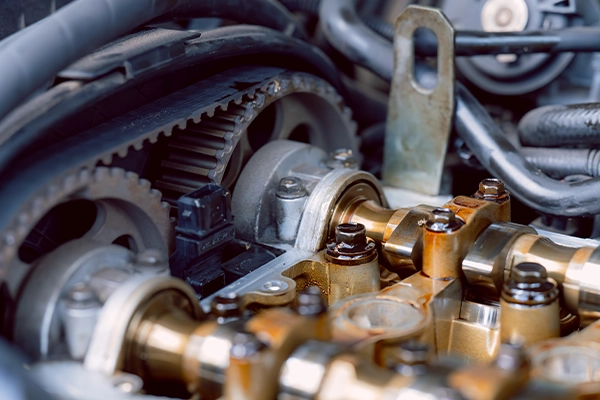
Squealing from the belt is often an early sign of belt failure, and should never be left to linger as timing belt failures often happen spontaneously and can result in irreparable damage to your engine.
Accessory Belt
The accessory belt, while similar looking to the timing belt, plays a completely different role in the vehicle. Accessory belts, also known as serpentine belts, are responsible for providing rotational energy from the engine’s output to the various “accessory” components that rely on it.
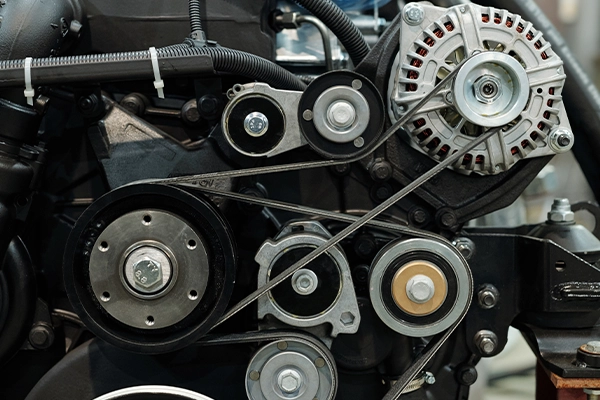
From the power steering pump to the alternator, many of your vehicle’s most important systems rely on a constantly running accessory belt. Similar to timing belts, accessory belts can degrade and fail in a similar way, while also producing that dreaded squeal from your engine bay.
Failing Power Steering Pump
While not directly an “engine” issue, a failing power steering pump can lead to a similar squeal or whine as you drive. If the sound increases or decreases based on the amount you are turning the steering wheel, there’s a good chance what you’re hearing is a power steering pump struggling due to internal failure, electrical issues, or low/contaminated hydraulic fluid.
Worn Pulley Bearings
The components that rely on the accessory belt’s rotation use pulleys to connect to the belt. These pulleys contain bearings that allow them to spin smoothly and without excess friction. When these bearings begin to fail as a result of damage or corrosion, the metal-on-metal contact may cause them to squeal as they spin.
Subaru Powertrain Service & Repair at Super Rupair in Boulder
If you drive a Subaru and are experiencing a similar squealing noise, don’t hesitate to reach out to the team at Super Rupair in Boulder for the area’s premier Subaru maintenance, inspection, and repair services. Our technicians are specially trained on Subaru platforms, meaning you can rest assured that your vehicle is receiving top-notch service from a team that truly understands it inside and out.
Don’t trust just any shop with the health of your Subaru, give us a call or schedule online today to secure your appointment with Boulder’s trusted independent Subaru repair facility!